Pune's Building Boom Needs Thousands of Trucks a Day. Its Roads Are the Ones Paying for It.
A road nobody can drive normally anymore
Residents along Dattanagar Chowk to Jambhulwadi Road, in Pune's Ambegaon area, say they've stopped trusting the asphalt under their own wheels. Their complaint, filed repeatedly with civic authorities and reported by Free Press Journal, is specific: ready-mix concrete (RMC) trucks rolling through with their drums not properly locked, leaving a trail of wet concrete that hardens into bumps and ridges within hours. Locals count more than 25 accidents from it in recent days alone - two-wheelers catching a ridge at the wrong angle, cars losing a wheel into a hardened lump mid-turn. Nobody from the civic side has independently confirmed that number, and no visible action has followed the complaints either, which is really its own kind of answer.
It would be a strange, isolated story if it were just this one road. It isn't.
The same complaint, three more neighbourhoods over
Go six kilometres south to Sinhagad Road and you find almost the identical sequence, just slightly further along. A cement spill from an RMC mixer there got enough attention that the Sinhagad Road Regional Office actually turned up, cleaned the mess, and fined the mixer's plant. Then nobody was assigned to keep the stretch clean, and mud heaps built back up within what residents describe as days - motorcyclists skidding on the same ground the fine was supposed to have fixed.
Undri has its own, older version of this fight. Residents there have been asking the PMC to shut down RMC plants operating inside residential pockets since at least this spring; Supriya Sule threatened to lead a protest outside PMC headquarters if the plants weren't closed by July 7, after the civic body had already promised, and missed, an end-of-May shutdown deadline. PMC Commissioner Naval Kishore Ram personally inspected one of those Undri RMC sites in September, after yet another round of complaints about dust, noise and road damage, and said the department would enforce proper SOPs going forward. The plants are, as far as public reporting shows, still there. Nine days later, on September 22, hundreds of residents from Raheja Reserve, Nyati and the surrounding Mohammadwadi-Undri belt staged a protest of their own, asking for the same thing: get the dumpers and mixers out, or at least off these specific roads.
That last one lands in the same general neighbourhood as a civic-grievance story we've already told on this blog about Mohammadwadi - but it's worth being precise about what's different here. That earlier post was about safety petitions following a fatal accident. This is a parallel, ongoing fight in the same area over who gets to drive two-ton trucks past your front gate, and it's been running since before that other story even started.
A crackdown and a loophole, arriving in the same year
Someone in the system clearly noticed the pattern, because Pune's RTO has been running an intensified inspection drive through this financial year - 4,219 heavy vehicles checked so far, 1,506 e-challans issued, specifically targeting tankers, dumpers and other commercial trucks after a string of fatal accidents. (One version of the same reporting cites much larger totals - 31,783 vehicles checked, 11,349 challans, ₹9.99 crore recovered - without explaining how that squares with the smaller figure; treat both as the same drive described two different ways by two different sources, not as two separate drives.)
At almost the same time, in the opposite direction, Pune Traffic Police relaxed things. From July 27, 2026, RMC mixers specifically - not dumpers, not tippers, not tractors or road rollers, which all stay banned exactly as before - were allowed to enter the city on Saturdays and Sundays, 6am to 5pm, on a trial basis, so construction sites wouldn't grind to a halt on weekends. The mixers got a few new conditions in exchange: 360-degree cameras, reverse-parking sensors, and a breath test for every driver before the batching plant lets the truck out. Barely a week later, on August 3, police were out booking RMC mixer and dumper drivers for ignoring the no-entry rules anyway - the same vehicle category the city had just tried to make an exception for, caught breaking the exception's own terms.
That's the actual shape of the problem: not one bad road, not one bad driver, but a city trying to let its own construction boom keep moving without quite deciding where the trucks that boom runs on are allowed to go.
What this has to do with a carpooling app
It's tempting to file all of this under "infrastructure problem, not a commuter problem" and move on. But every dumper, mixer and tipper on Dattanagar-Jambhulwadi or Sinhagad Road is sharing the same finite width of tarmac as every solo commuter inching toward Hinjewadi or Kharadi - and unlike the commuters, the trucks aren't optional traffic. The city needs them to build the housing its population growth demands. What it doesn't need is every one of those housing projects also generating a few thousand extra solo car trips a day on top.
That's really the only lever ordinary commuters actually control here: not the trucks, but how many separate cars show up for the rest of the traffic. A road that's already absorbing unplanned heavy-vehicle wear and tear has a little more give left in it when four people share one car to work instead of driving four. It's a small thing against a crore-scale enforcement problem - but it's the one piece of this picture an app on your phone can actually move.
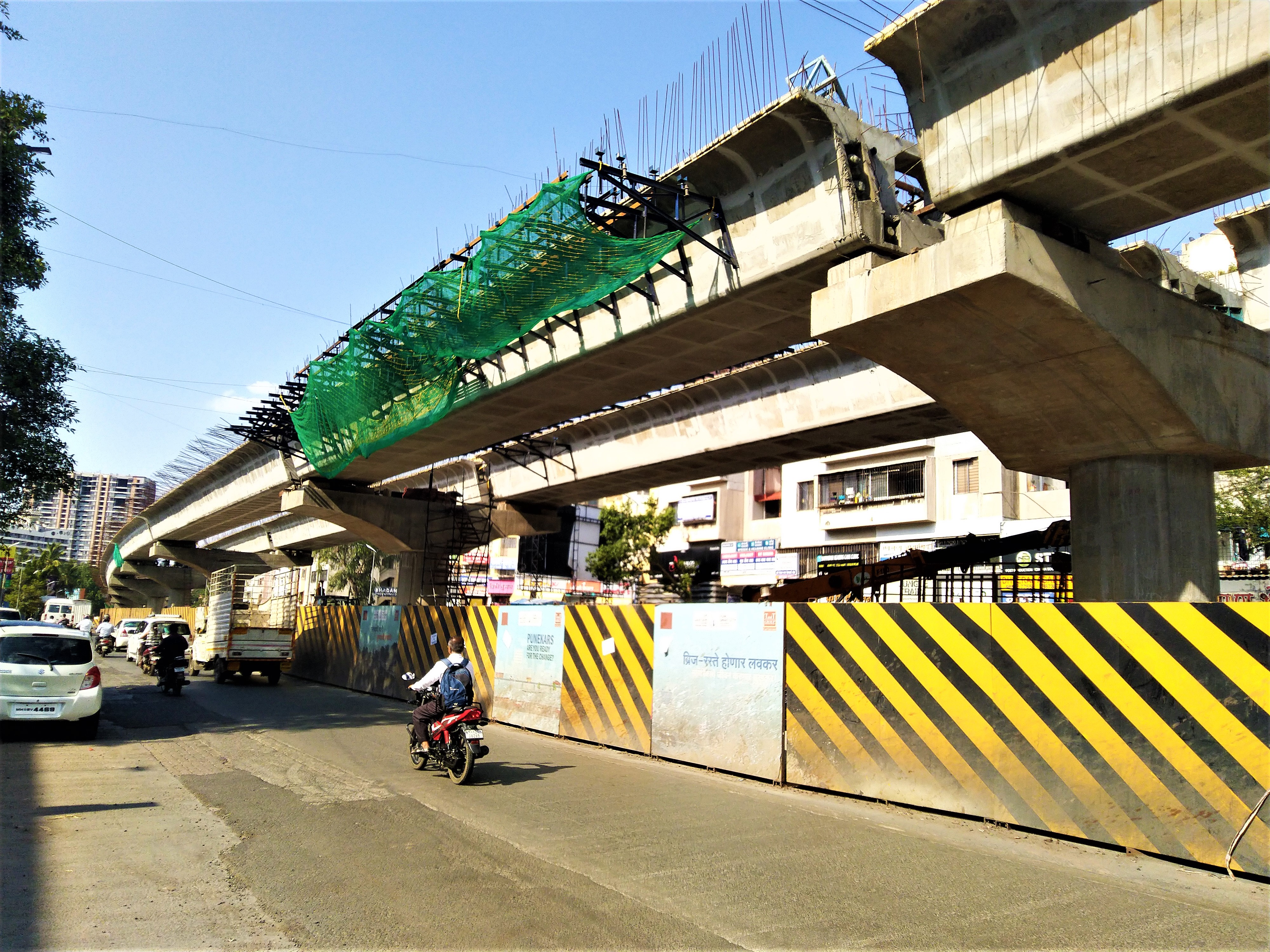
Cover photo: flyover construction work-in-progress on Sinhagad Road, Pune, by DesiBoy101 / Wikimedia Commons, CC BY 4.0.
Ready to try GoVia?
Share rides, join bike pools, and send parcels with trusted travelers near you.
Download the GoVia app