Hinjawadi Buried Its Bus Service Five Years Ago. Now Chakan Wants the Comeback Too.
In 2014, the Hinjawadi Industries Association and MIDC put a bus on the road and called it MetroZip. It did the one thing nobody else was doing: picking up IT-park employees from their own neighbourhoods and dropping them at their own office gates, on a schedule a company could actually plan around. Then it quietly stopped running. The pandemic gets the official blame, and it's a fair one — but whatever the cause, Hinjawadi went roughly five years without the service, which tells you something about how hard it actually is to keep a private bus network solvent in a city where everyone eventually just buys a car instead.
It came back on May 5, 2026, rebranded as COCO Rides and run by a mobility company called Routematic, still in partnership with HIA. This time it launched with real scale behind it: something like 80 buses across 70 routes and 500-plus pickup points, already said to be carrying 3,000 to 4,000 employees a day within weeks. HIA's own membership — more than 80 companies — adds up to a potential rider base north of 1.25 lakh people, and later coverage has the network stretching past 200 routes within months of launch. Riders book a seat in an app, pick a fixed route and time, and get GPS tracking and an SOS button thrown in. It is, by the numbers, a genuine comeback.
It's also still a fixed-route, fixed-timetable service — which is exactly where it runs out of road.
A bus network built around named routes and set departure times is a good match for one kind of commuter: the one whose shift starts and ends at the same time as everyone else's. Hinjawadi doesn't actually have very many of those anymore. IT companies stagger start times to spread elevator and parking-lot load, security and facilities teams work rotating shifts, and anyone supporting a US or European client is, by definition, working hours nobody else in the building keeps. A bus that leaves Baner at 9:15 is exactly on time for a 10 a.m. log-in and exactly useless for a 7 p.m. one.
This is the gap a report out of Pune this week says PMPML is finally trying to close — and not just in Hinjawadi. On November 19, the transport body said it plans to design shift-based bus services for Hinjawadi IT Park and, separately, for the Chakan industrial belt, by going company by company and collecting actual headcounts, shift patterns and commute routes before setting any route or timetable. That's a plan, not a rollout yet — there's no start date on record, and nothing I found suggests a single bus has moved under this scheme so far. But the logic behind it is the right one: ask the employers what the shifts actually look like, then build the service around that, instead of the other way round.
Chakan matters here precisely because it isn't Hinjawadi. It's industrial, not IT — shop-floor shifts, not laptop hours — and PMPML already runs fixed circular routes through places like Ambethan Chowk and Mahalunge to serve it. Dilip Batwal of the Federation of Chakan Industries put the employer-side case plainly to reporters: buses that actually line up with shift timings cut what workers spend getting to work, and pull some of that traffic off Chakan's own congested approach roads. It's the same problem Hinjawadi has, wearing an industrial-belt uniform.
None of this is really PMPML's fault for being slow, or Routematic's for building something fixed-schedule in the first place — a fixed schedule is what lets a company sell a bus pass at a fixed price and know roughly what it costs to run. The honest shape of the problem is that shift work doesn't compress into a handful of departure times, no matter how many of them you add. Even a well-run network with 70, or 200, routes is still choosing a finite set of times and hoping enough people's shifts cluster around them. Someone starting at 6 a.m. or finishing at 11 p.m., or working a day that just doesn't match Monday-to-Friday, will keep falling through that net regardless of how good the bus service gets.
That's the gap carpooling is actually built for — not as competition for COCO Rides or whatever PMPML eventually rolls out, but as the thing that covers what a scheduled network structurally can't. A shared ride doesn't need a published timetable; it needs two or three people whose shifts happen to line up on a given day, which is a much easier thing to find than an entire busload of them. For the Hinjawadi employee on a staggered 11-to-8, or the Chakan shift worker whose factory day doesn't match anyone else's office hours, that's the commute a bus route was never going to solve — fixed schedules and flexible ride-sharing solving two different halves of the same traffic problem, not fighting over one.
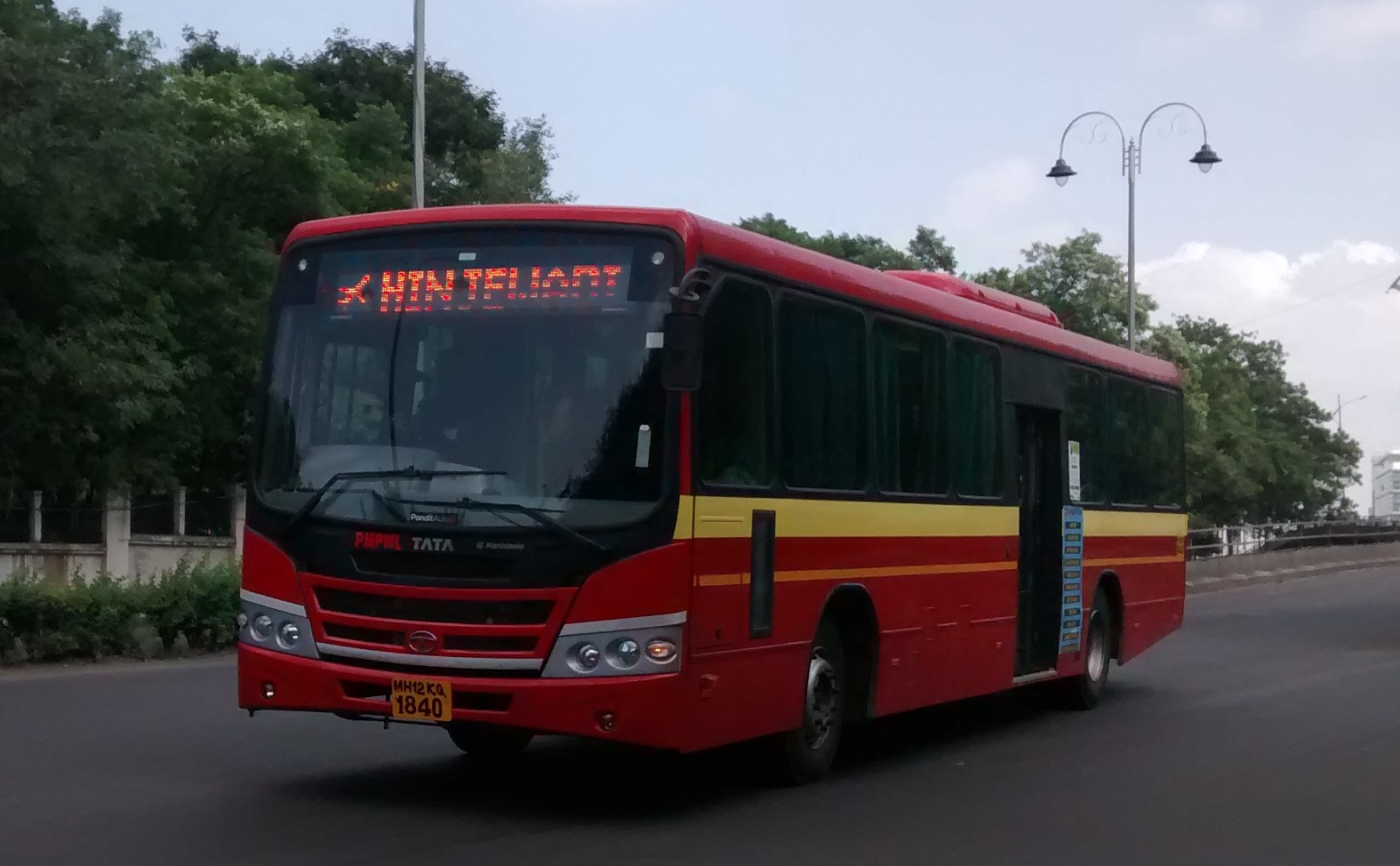
Cover photo: PMPML AC bus, Hinjewadi — Rsrikanth05, via Wikimedia Commons, CC BY-SA 4.0.
Ready to try GoVia?
Share rides, join bike pools, and send parcels with trusted travelers near you.
Download the GoVia app